


- You are here:
- Home

- Arts & Entertainment
Entertainment Spotlight
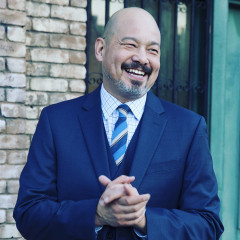
Actor Tim Lounibos - Hopeful Opportunities Ahead for APA's in Hollywood Movies and Television
Arts & Entertainment
Astronaut Leroy Chiao's Space Blog-Corrientes, Argentina
This is a good example of what is possible using space-based astronaut photography.
This is a very striking photo. It was taken using a hand-held 800mm lens. With the longer lenses, one must develop the technique of matching the earth's rotation during the composition of the photo. We shoot at 1/500 s, aperture priority, but even so, one must compensate to prevent smearing of the image. Adequate lighting and atmospheric conditions are also factors. In this case, it all came together. You can see the sunglint on the river, which reveals very sharply, the flow and subsurface flow patterns of the water. The bridge is well-defined as are the individual streets of the city. This is a good example of what is possible using space-based astronaut photography.
Dec. 10, 2004 Blog Malaysia Patagonian Glaciers Bolivia
Click here for AsianConnections' exclusive interview with Leroy while in training at Star City, Russia.
Information
on
the
crew's
activities
aboard
ISS,
future
launch
dates,
as
well
as
Station
sighting
opportunities
from
anywhere
on
the
Earth,
is
available
on
the
Internet
at:
http://spaceflight.nasa.gov/
U.S. Astronaut Leroy Chiao's blog and all NASA updates at AsianConnections.com are monitored by AC Editor Lia Chang
Astronaut Leroy Chiao's Space Blog-Mozambique
Astronaut Leroy Chiao's Space Blog-postcard of Mozambique
This shot of the coast of Mozambique was very surprising. The different colors of the mud and sand form very beautiful and interesting patterns. One can see how the local currents in the water shaped the sand bars. The African coast along this region contains many such islands.
Corrientes, Argentina Dec. 10, 2004 Blog Malaysia Patagonian Glaciers Bolivia
Click here for AsianConnections' exclusive interview with Leroy while in training at Star City, Russia.
Information
on
the
crew's
activities
aboard
ISS,
future
launch
dates,
as
well
as
Station
sighting
opportunities
from
anywhere
on
the
Earth,
is
available
on
the
Internet
at:
http://spaceflight.nasa.gov/
U.S. Astronaut Leroy Chiao's blog and all NASA updates at AsianConnections.com are monitored by AC Editor Lia Chang
Astronaut Leroy Chiao's Space Blog-live on NASA TV on Dec. 29
On Wednesday, Dec. 29, live on NASA TV, starting at 11:45 a.m. EST, Flight Engineer Salizhan Sharipov and I are hosting a press conference from the International Space Station.
Hi Lia
Thanks. We are glad the Progress made it on board.
On Wednesday, Dec. 29, live on NASA TV, starting at 11:45 a.m. EST, my crewmate Flight Engineer Salizhan Sharipov and I are hosting a press conference from the International Space Station.
We'll be unloading our shipment of supplies from the Russian Progress cargo spacecraft, which arrived Christmas night.
Since mid-October, we've been living on the Station conducting science experiments, maintaining operating systems and are prepping for spacewalks scheduled for January and March.
Tune into our news conference which will be telestreamed live on the Internet at: http://www.nasa.gov/ntv
NASA TV is available via the Web and satellite in the continental U.S. on AMC-6, Transponder 9C, C-Band, at 72 degrees west longitude. The frequency is 3880.0 MHz. Polarization is vertical, and audio is monaural at 6.80 MHz. In Alaska and Hawaii, NASA TV is available on AMC-7, Transponder 18C, C-Band, at 137 degrees west longitude. The frequency is 4060.0 MHz. Polarization is vertical, and audio is monaural at 6.80 MHz.
Corrientes, Argentina Dec. 10, 2004 Blog Malaysia Patagonian Glaciers Bolivia
U.S. Astronaut Leroy Chiao's blog and all NASA updates at AsianConnections.com are monitored by AC Editor Lia Chang